In this article:
Alstom Ferroviaria: the automotive industry and industrial painting at top speed
How can you speed up the industrial painting and paint curing steps impacting so heavily on production times?
One of today’s crucial problems in industry is facing production peaks without having to cope with investments that could prove unsustainable in the long term. A recurrent situation in the automotive industry, constantly focused on the search for speed and production increase.
Is it really possible to boost productivity by drastically reducing paint drying times, before facing huge costs in the implementation of new systems?
Below we will get to the heart of a real case, showing you how Movingfluid, commissioned by Alstom and working jointly with the customer, managed to significantly curtail the industrial painting times for wagons.
A result obtained by using infrared radiation curing in paint drying, a technology successfully applied to such large surfaces for the first time.
We will quantify the benefits of the solution in detail, in terms of time reduction and greater profit generated.
This successful challenge is intended to be a good omen for all those industries that find themselves in the difficult situation of having to manage space problems, while needing to boost productivity. For all those tenacious entrepreneurs who want to satisfy the customer with excellent performance in terms of delivery times and quality, challenging an increasingly unstable and demanding market.
In Alstom’s case, with a plant that cannot be expanded further, it being located in an area of high urban density, the investment in a new paint furnace for trains would have also involved the construction of all the surrounding infrastructure. Buildings, transport lines, as well as the construction of the whole system for moving wagons from where they are painted to where they are used: an investment worth several million euros.
The challenge launched by Alstom: industrial painting of wagons with drying in record time
With an annual turnover of about 8 billion euros, 8 production sites in Italy, 31 warehouses and 3200 employees, Alstom Ferroviaria is a brand of excellence for the Italian industry. Its product portfolio ranges from high-speed trains (subways, monorail vehicles, electric trams and buses) through to integrated systems, customised services, infrastructures, signalling and digital mobility solutions.
A brand that looks to the future by placing technology at the service of sustainability, as demonstrated by the project it is currently working on: the development of a hydrogen train, for finally green railway transport.
Alstom’s products include Italo high-speed carriages, regional trains for Trenitalia and those for Amtrak USA.
For Movingfluid, it was an honour to support Alstom and contribute to implementing a major production upgrade of the existing plant. An ambitious project which, as is often the case, posed a great challenge in terms of real feasibility.
The requests that Alstom’s purchasing department presented to us, as experts in fluid handling, were essentially two.
1) Production increase
To find a solution that would reduce the curing times of the trains after the industrial painting phase. The ultimate goal? To increase productivity by making use of the existing oven and therefore avoiding the construction of a new facility.
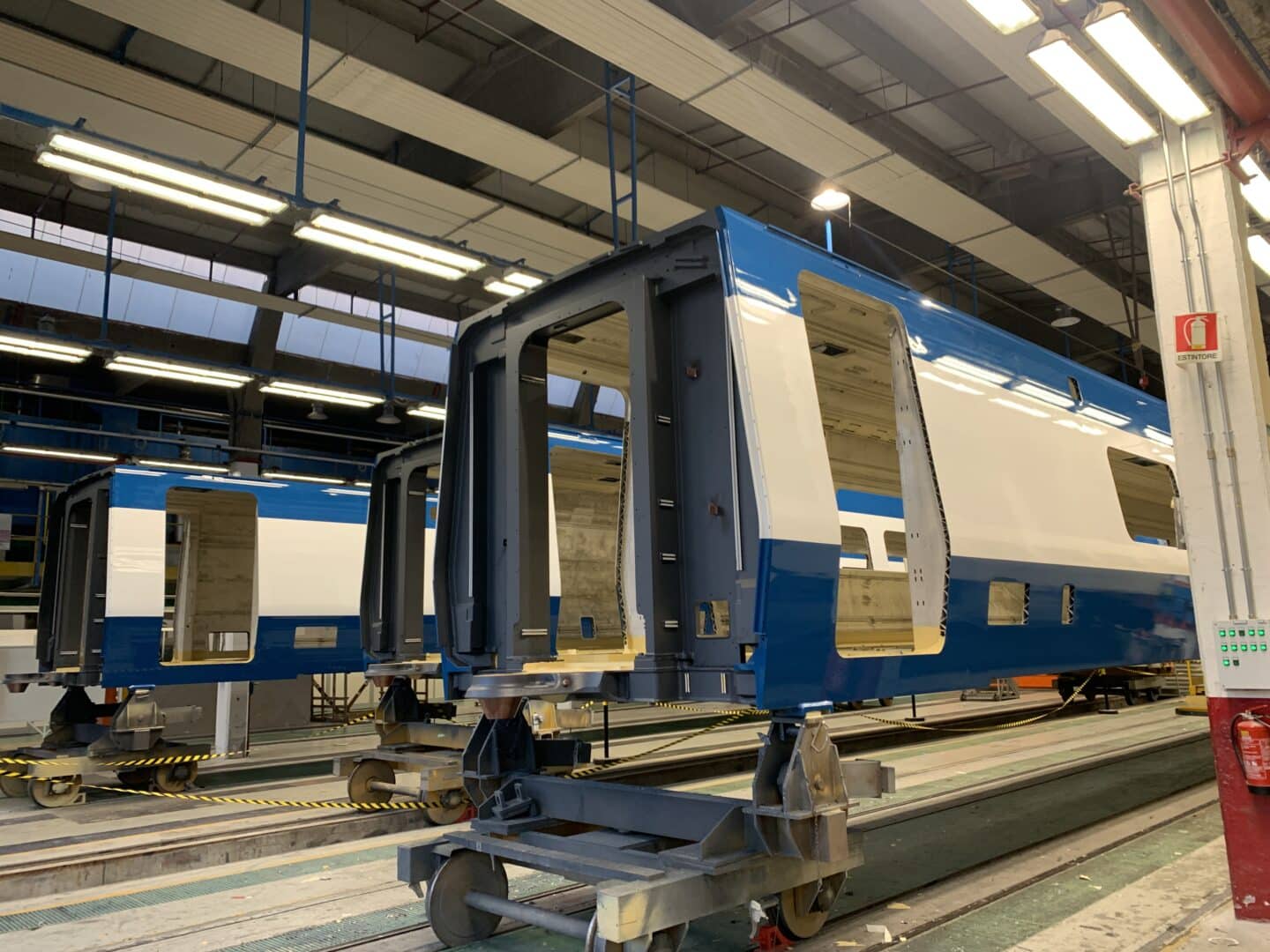
Specifically, the need to increase production capacity referred to the industrial painting process of the Amtrak carriages (paint colors: white and blue) and the NTV ETR 675 carriages (paint colors: red and black).
2) Skilled labour in the area
Our client explicitly requested to rely on Italian plant engineers operating locally. As often happens, many foreign companies offer solutions whose implementation is then assigned to foreign labor or to subcontractors located in the target area. Most of the time, these workers lack expertise in the sector and, operating on behalf of third parties, often end up creating an additional problem for the company.
In this case, selecting professional collaborators – both from a design and a techinical standpoint – was a priority. Our organization, operating throughout Italy, allows us to stay close to our clients at all times, solving ‘impossible headaches’ not only in the office but also directly on-site. Movingfluid’s plant engineers are in fact highly specialized in the assembly of paint-curing oven booths, with expert personnel dedicated exclusively to this activity.
Handing over the baton to Movingfluid: towards the solution
Our engineering consultants joined Alstom’s Research and Development Department while a major thought was being taken into consideration. Having treated carriages in a Geico thermal convection furnace up to that point, Alstom was actually considering converting its hot air furnace to IR technology, in order to speed up the drying process.
Paint curing with IR technology occurs by directly radiating the surface, while the traditional hot air furnace generates a curing process by heating the surrounding environment. Hence, greater inertia required to cool the carriage, and much longer times.
However, including the infrared treatment in the industrial painting process raised considerable doubts as to whether paint could be evenly cured. As a matter of fact, infrared technology had never been used on such large surfaces.
How could a result be guaranteed before starting to invest in that direction?
These are the starting points: the total time needed to go through the convection furnace for a carriage to be industrially painted was 100 hours, as detailed below for each step.
Below is the summary table for each phase:
| Step | Traditional hot air convection furnace time (including flash off) |
|---|---|
| Primer/Undercoat | 8h at 60°C |
| Transparent | 8h at 25°C |
| Gloss enamel | 8h at 40°C |
| Plaster | 4h at 25°C |
| Extra drying before packaging |
72h at 60°C |
A surge in productivity exceeding expectations
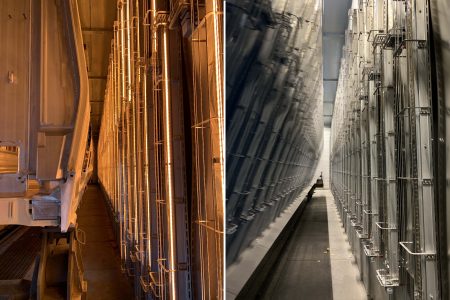
To reduce paint drying time and increase productivity, Movingfluid installed 234 infrared lamps, with a total power demand of 800 Kw, mounted on frames inside the furnace structure.
A new dedicated Electrical Panel was created, with various underground installed lines branching off from it, for the workers to transit through easily and in total safety.
These lamps are controlled by a specific PLC managed based on advanced logics.
Our technical skills made it possible for us to prove the validity of the proposed solution through field tests.
After one day of trials and two weeks of laboratory tests – strictly carried out by an independent and certified company, chosen by the customer – the analysed samples were validated and declared fully satisfactory according to Alstom standards.
After converting the furnace and adopting IR technology for paint curing, this is the performance achieved showing a 12.5 shorter production time compared to a hot air convection furnace.
Below is the summary table for each phase:
| Step | Targets achieved with IR |
|---|---|
| Primer/Undercoat | From 15 min to max 1h |
| Trasparent | From 30 min to max 2h |
| Gloss enamel | From 30 min to max 2h |
| Plaster | From 20 min to max 1.5h |
| Extra drying before packaging | Max 2h |
The total paint curing time for a carriage thereby decreased from 100 H to 8 H: practically just one day
For Movingfluid, another challenge successfully solved!
All the advantages of the Movingfluid’s solution
1) Increased production capacity
The solution put forward by Movingfluid by leveraging its masterful technical skills resulted in a curing time reduction for a carriage by 1150% (from 100 to 8 hours) with a consequent productivity boost.
Not only that: thanks to the conversion of the existing paint furnace, Alstom was able to save on investments in new facilities, as well as avoiding the risks associated with them due to an irregular market trend, thus ensuring its customers continuity and excellence in service.
2) Solution at no cost for the customer, subject to successful completion
The Movingfluid method is based on totally sharing the challenge to be faced with the customer and on continuous alignment work. For this reason, until the customer completely approves the proposed solution, the costs of the project are fully paid in advance by Movingfluid.
3) Optimisation of construction site times
Alstom’s decision to make use of expert workers and qualified partners in the area, able to provide the most technologically advanced solutions, proved to be crucial. Not only because managing construction site activities proved to be effortless for the customer, but also for the ability of the Movingfluid team to effectively cope with the operational restrictions brought about by the pandemic. Production was indeed streamlined during the COVID-19 emergency.
To keep the construction site open and complete the work on time, Movingfluid’s plant engineers were constantly and effectively in contact with Alstom’s HSE (Health, Safety & Environment) and with Turin’s and Cuneo’s prefects. Construction times thereby fell perfectly within Alstom’s only period of annual production downtime, lasting a total of three weeks, without implying any production stops.
The new infrared-ray wagon paint curing technology marked a turning point in Alstom’s production methodology, so much so that it led the Company to evaluate whether this solution could be extended to other European plants.
A further evidence of Alstom’s ability to always look ahead and overcome previous limits, in pursuit of ongoing improvement. To shape the future of mobility, but not only that.
If you have industrial fluids in your plant, your productivity can be improved.
How? Let’s find out together.
- Airless painting [1]
- Alstom [1]
- ARO Ingersoll Rand [1]
- Atex diaphragm pump [1]
- Atex pumps [1]
- Automatic glue dilution [1]
- Automatic tissue machines [1]
- Automotive [8]
- Automotive carbon [1]
- Automotive fluid distribution [1]
- Brembo [2]
- Carbon bonding [1]
- Carbon bonding and curing [1]
- Carbon bonding plant [1]
- Case History [13]
- Cast iron brakes [1]
- Centrifugal pump [1]
- Ceramic [3]
- Chemical [3]
- Chemical mixer [1]
- Chemistry [2]
- Cleaning [1]
- Cleaning industrial machinery [1]
- Dilution [1]
- Dosage [4]
- Dust [1]
- Electric diaphragm pumps [1]
- Electric double diaphragm pump [1]
- Extrusion [3]
- Finishing [1]
- Fluid for hybrid or electric vehicles [1]
- Fluid handling [4]
- Fluids [2]
- Food [1]
- Freni in ghisa [1]
- Gases [3]
- Glue [2]
- Glue Dilution [1]
- Glue dilution for paper rolling [1]
- Handling for the graphics industry [1]
- Henkel [1]
- How a centrifugal pump works [1]
- Hybrid cars [1]
- Impianti verniciatura industriale [1]
- Industrial bonding [1]
- Industrial paint booth [1]
- Industrial Painting [4]
- Industrial pump [1]
- Industrial tile painting [1]
- IVECO [1]
- Know-how [2]
- Körber Tissue [2]
- Lamborghini [2]
- Linea automatica verniciatura manicotti [1]
- Liquid paint [1]
- Liquids [6]
- LPR [1]
- Market news [4]
- Mixing chemicals [1]
- Nikola [1]
- Oenology [2]
- Oil & Gas [1]
- Ozone sanitiser [1]
- Ozone sanitization [1]
- Packaging industry pump [1]
- Paint [2]
- Paint booth [1]
- Paper [2]
- Paper converting [1]
- Paper industry [2]
- Pneumatic powder conveying [2]
- Polcart [1]
- Powder Coating [1]
- Powder conveying [2]
- Powder conveying pumps [2]
- Powders [1]
- Printing industry pump [1]
- Professional ozone generator [1]
- Professional ozone machine [1]
- Pump test bench [1]
- Raw material producer [1]
- Refrigerant distribution [1]
- Refrigerant system [1]
- Refrigerant with low electrical conductivity [1]
- Room ozoniser [1]
- Saipem [1]
- Spraying [5]
- Streparava [1]
- Structural bonding [1]
- SuperSix [1]
- Synthesis Spa [1]
- Tile [1]
- Tile painting [1]
- Tissue [3]
- Tissue converting [3]
- Tissue converting machines [1]
- Tissue glue dilution [1]
- Tissue industry glue mixing [1]
- Tissue machines [1]
- Toscotec [1]
- Trail [1]
- Transfer [7]
- Verniciatura industriale [3]
- Verniciatura industriale tubi [1]
- Verniciatura interna tubi [1]
- Verniciatura manicotti [1]
- Verniciatura tubi [1]
- Verniciatura tubi OCTG [1]
- Vortex hydra [1]
- Wood paint booth [1]